Argentine lawyer from Global Sumud Flotilla reports on torture of activists in Israeli detention
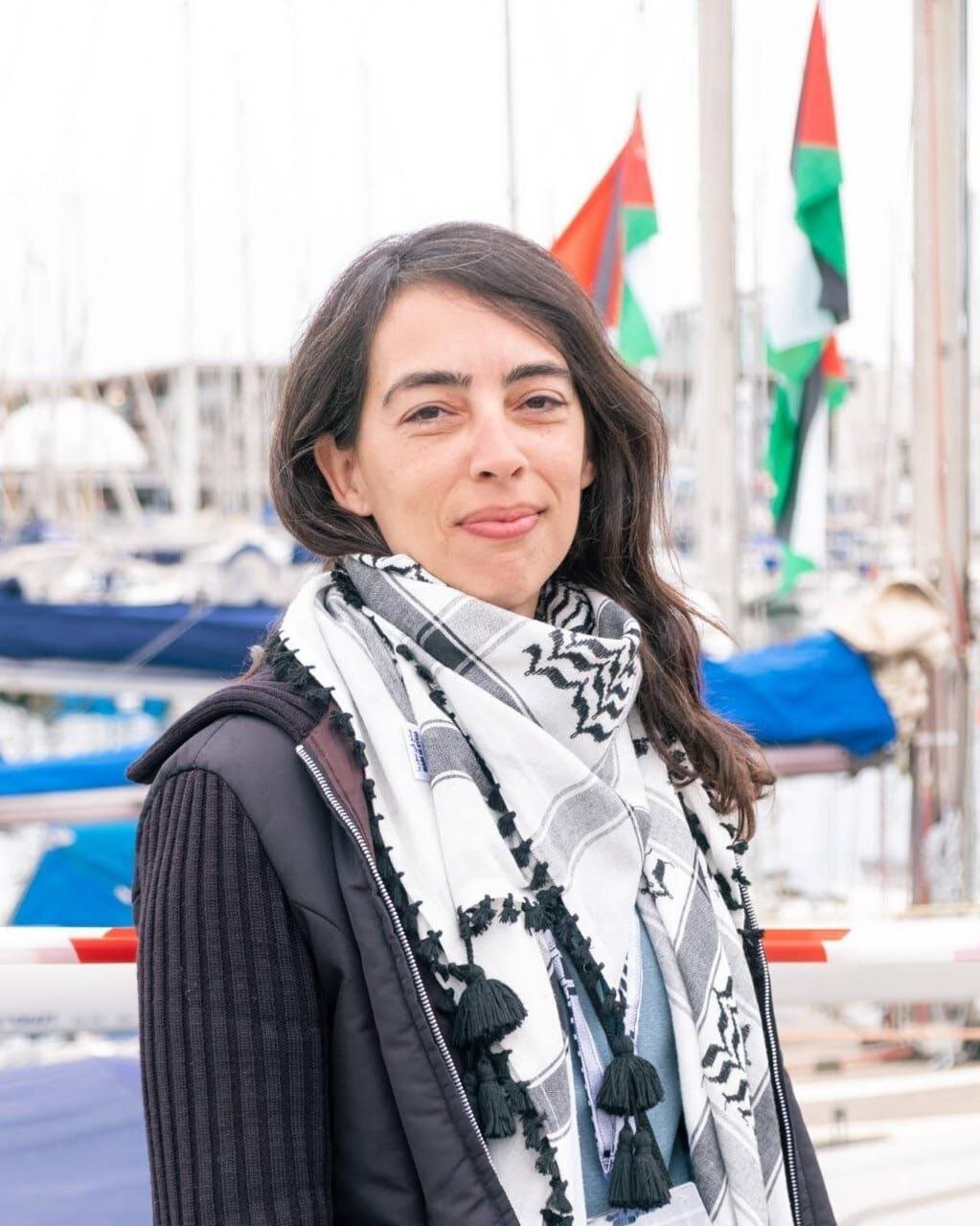
BUENOS AIRES — A member of the Global Sumud flotilla, Argentine lawyer and activist Victoria Pi de la Serra, describes an ordeal marked by violence, humiliation, and psychological torture.
Her testimony forms part of a new international mission that, for the second consecutive year, attempted to reach Gaza to denounce the Israeli blockade and draw attention to the humanitarian situation in Palestine. She was detained on May 18 and released on May 21.
Talking to the Tehran Times, she says, “There was a systematic organization of violence.”
Here is the full text of the interview:
Where were you held captive?
My flotilla was intercepted while we were sailing on yachts. Fast boats approached us from several military vessels. There were three vessels in total. Two of them had been converted into clandestine detention centers at sea—what could be described as floating prisons. They used shipping containers to create enclosed yards surrounded by barbed wire, and they placed people there as they intercepted them.
There were two such vessels. On ours there were two of these enclosed yards. As they intercepted people, they would transfer them onto these ships. It depended on when you were intercepted. I spent nearly 48 hours under those conditions until we arrived at the port of Ashdod. Then we were taken to Zion Prison, where we remained for another 24 hours before finally being transferred to the airport and released.
Why were you treated this way?
I assume that the constant threat was that we would remain detained at least until Sunday or Monday, but in the end, they released us on a Wednesday. What also happened was that the day before, Itamar Ben Gvir publicly disclosed the operation and the treatment we were receiving, which triggered an international scandal.
In addition, because there were so many of us, everything accumulated. Even officials such as Netanyahu had to publicly distance themselves from the situation. I do not think they wanted to keep us for too long. My impression is that they wanted to make an example of us: to create an intense, violent but brief experience in order to instill psychological terror and then get rid of us.
Was it possible to reach Gaza in the past?
Yes, at other times it was. Of the most recent missions organized by the Global Sumud Flotilla, this was the second; the first took place last year. There had been previous attempts, such as the one from Malta, which did not succeed, and the Egyptian convoy, which also failed to reach Gaza.
However, among the earlier flotillas organized by the different groups that make up this coalition, five missions did succeed in reaching Gaza.
What did they do there? Did they stay?
Those missions organized groups of volunteers who remained for a certain period of time in order to help distribute the supplies they brought and assist in any way they could: medical personnel, educators, skilled workers, mainly people involved in reconstruction efforts and humanitarian assistance.
How do you think the international community reacted?
There seems to be more attention abroad, particularly in Europe, than in Argentina or Latin America.
How is that attention managed, given that it can appear to be a symbolic gesture with limited results?
In reality, it has several dimensions. At first, media coverage was rather limited, but after the detention of activists such as Thiago Ávila and Saif Abukeshek, the situation gained visibility. Then, with the circulation of Ben Gvir’s video, the international impact exploded.
This forced various governments to issue statements, even if only minimal ones. Even without concrete action, they had to respond publicly. That is also part of the purpose of the action: to make visible what is happening. In that sense, even though we did not reach our destination, the impact was significant.
Especially considering that these are civilians acting without government support?
Exactly. That is central. It is a direct civilian action without state backing, and that alone carries political significance. It demonstrates the capacity for collective organization in the face of governmental absence or complicity.
It is also an experience of diversity: people from different countries, cultures, languages, and political and personal backgrounds coming together in a common action.
Another very noticeable aspect is the difference between the Global North and the Global South. In the Global North, the Palestinian issue is far more present in public life. In Barcelona, for example, you can see Palestinian flags hanging from balconies on almost every block, and there is a much more constant social mobilization.
In Italy, for example, the dockworkers’ strikes that blocked the departure of ships carrying military supplies generated political pressure and forced Meloni’s government to take positions, however reluctantly.
In Greece, the situation was different. There was state complicity in the first interception on April 29, which took place in international waters, albeit within a rescue zone. The coast guard never appeared. Later, Greece agreed to receive some of the released volunteers, but not all of them; some were transferred to an Israeli prison.
Israeli authorities even thanked the Greek government for its cooperation. Yet the response of civil society was completely different. In Greece, people opened their homes to released volunteers, providing food, clothing, and accommodation. The contrast between governments and civil society was striking.
Did you have any contact with authorities?
No, none at all. Sometimes even port authorities, who were implementing government policies, behaved more kindly in practice because many of them agreed with what we were doing.
There was a tension between political decisions and their implementation. At times, the employees responsible for enforcing the measures were far more cooperative than expected.
Were there cases of more extreme violence?
Yes. There was a systematic organization of violence. On the vessel where I was held, we were not treated the same way as other groups. There were two enclosed yards on my ship, and each group received different treatment.
The other ship experienced greater violence. I do not know exactly why—whether because of nationality or organizational logic. I was the only Argentine on my vessel; the other Argentines were on a different one, where they suffered more beatings and abuse.
When people were intercepted, the military formed a corridor through which they were forced to pass while being struck, groped, and stripped of clothing. In some cases, there are testimonies alleging sexual abuse.
During transfers and in detention centers, the atmosphere was one of total disorientation: people were constantly moved from one cell to another, never allowed to remain in one place for more than fifteen minutes. They were thrown to the ground, pulled back up, handcuffed with their hands either in front of or behind them, all amid constant shouting.
The soldiers wore no identification and covered their faces with balaclavas. It was a deliberate policy designed to prevent individual accountability.
Why do they do that?
It is a deterrence mechanism. The goal is to generate fear: to prevent you from accomplishing your objective, to make you unwilling to return, and to ensure that you know the next time could be worse.
It functions as a warning. However, what has actually happened is that there are increasingly more volunteers, more vessels, and greater determination.
Leave a Comment